“There is no Planet B.” “Keep it green, keep it clean.” “Plant trees, not excuses.”
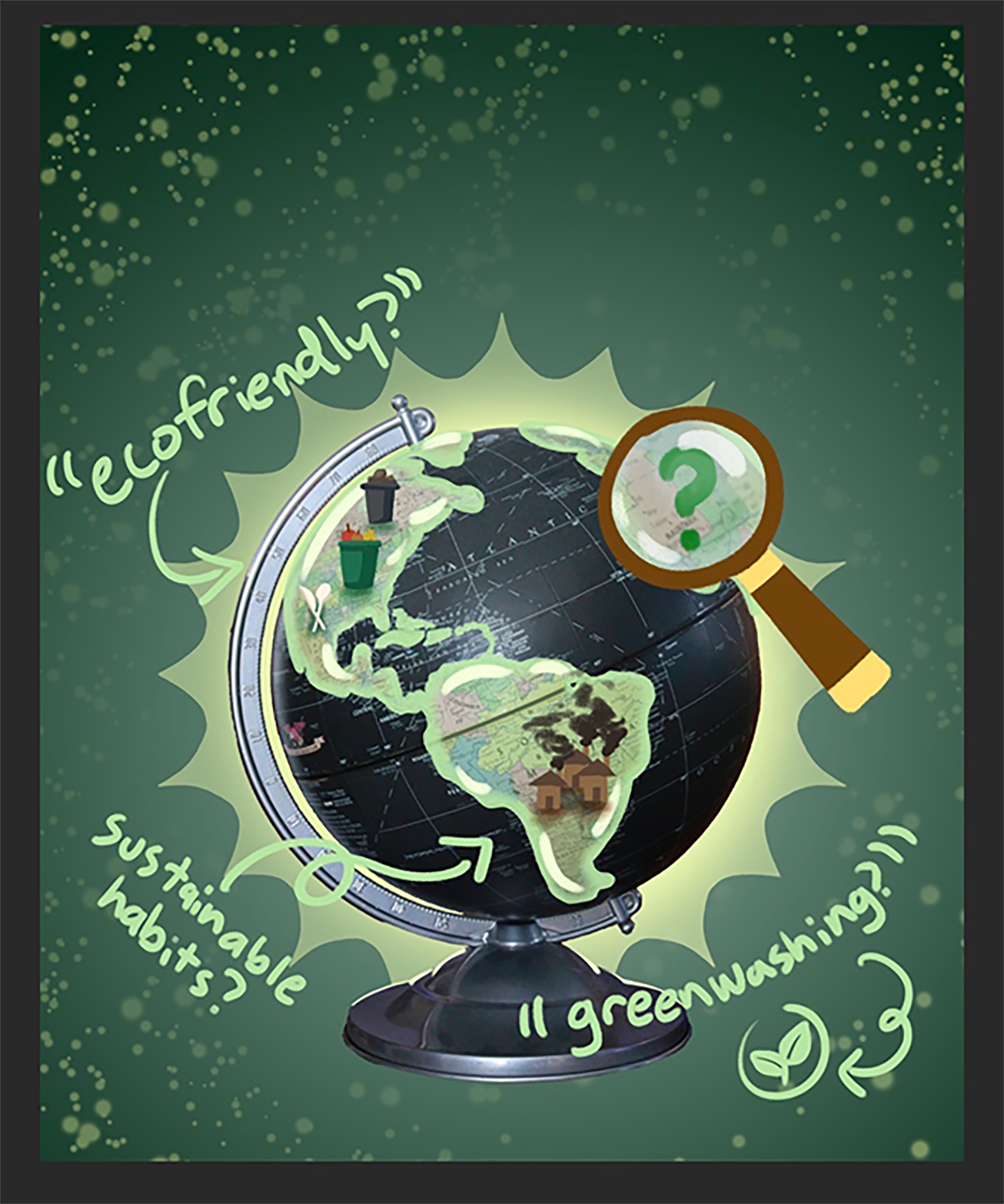
As Earth Day (April 22) approaches, these popular phrases exemplify the trendiness of eco-friendliness. But environmental sustainability means managing natural resources to meet current needs without compromising future generations’ environmental conditions—and this requires consistent and responsible action, not just slogans. To maintain Earth’s beautiful ecosystem and the survival of all its inhabitants, people must distinguish between surface-level eco-consciousness and deeper, more engaged sustainability.
In a world where climate change is wreaking havoc, protecting this planet is more important than ever, but how green are people really?
Habits at Home
When it comes to sustainability, personal habits at home are often overlooked in the name of convenience. However, these routines have some of the most significant environmental impacts and tackling them can decrease household carbon footprints.
According to the US Environmental Protection Agency (EPA), transportation in the United States accounts for almost a third of the country’s total greenhouse gas emissions. Almost two-thirds of all commutes contain just one passenger, meaning more cars jam roads and create increased amounts of carbon dioxide.
Senior Mimi Davison, president of the Environmental Board, acknowledges students’ participation in this issue.
“Because so many students drive to school every day, I think transportation and our lack of carpooling and other more sustainable transportation methods create a massive impact,” Davison said.
Public transportation is a popular alternative to driving, especially in major U.S. cities and countries around the world. Junior Vittoria Sofia Testa, a student who actively tries to be more sustainable in her daily habits, enjoys the unique experience of public transit.
“Whenever I’m in different cities or countries, I love public transportation,” Testa said. “Beyond just being better for the environment, you see so many cool people. It’s really interesting.”
The hardest habits to give up are often smaller routines that people dismiss easily. According to the Carbon Disclosure Project, buying a coffee every morning can produce as much as 100 kg of carbon dioxide yearly. Shopping is a source of significant greenhouse gas emissions because of the energy needed for producing, packaging and transporting goods. Sustainable brands help reduce these emissions by using less energy, relying on clean resources and minimizing waste.
“Less plastic has definitely been the hardest habit for me,” Testa said. “If you go to the grocery store, everything is packaged in plastic. But I try to buy all my makeup from sustainable brands, try to buy things that aren’t in plastic or do my research to make sure a company isn’t just pretending to be sustainable.”
However, shopping sustainably is often more expensive. Eco-friendly options, especially in the clothing sector, can cost as much as 75 percent more than cheaper, more environmentally damaging ones, according to research from Kearney. While green purchases may require a larger initial investment, it pays off in the future.
“The reality is that making eco-friendly choices may cost more upfront but save us a lot of money in the long-run, and are therefore the more economical options,” Davison said. “Buying a pair of more expensive pants that you will wear all the time and will last for decades is cheaper than buying a pair of less expensive pants that will only last a few months.”
Choices can be both cost-effective and more efficient. For instance, showering drains money while producing hundreds of kilograms of carbon dioxide yearly. According to the BBC, taking shorter showers instead of baths could save 849 kg of carbon dioxide yearly for a family of four.
“A few summers ago, I started taking really cold showers in the morning and that’s both better for the environment, but it’s also really good for your health,” Testa said. “Shorter showers definitely make a difference. Water is a huge resource that’s going to be depleted in the next couple of decades, so it’s important that we ration it and only use it when we really need to.”
Yet another obstacle that dissuades many from adopting more eco-friendly choices is the global outlook on climate change. According to the European Geosciences Union, Earth is predicted to reach the “point of no return,” where human damage to the planet becomes irreversible, before 2035.
“Climate change feels like a distant, threatening issue to many of us; it’s easier to keep it out of sight and out of mind,” Davison said. “It’s hard to attach our daily choices to the catastrophic consequences playing out across the world. It’s important to not view climate change as scary and distant, though, and to recognize that our positive actions, much like our negative actions, have the potential to make massive impacts.”
Here at Hockaday
From SAGE composting to environment-focused Social Impact student clubs, Hockaday plays an active role in limiting climate impact. Despite this long-term dedication, daily actions of Hockaday students, including excessive food and paper waste, can often have unintentionally harmful consequences.
Joan Guzman, Chief Operations Officer, said efforts are ongoing to reduce single-use products, like the SAGE to-go containers, and explains how Hockaday works to minimize harm to the planet.
“I think that we’re very mindful about the products we’re purchasing, recyclable and biodegradable products whenever possible,” Guzman said. “We also look at building materials and cleaning products that are less harmful to the environment. At times there’s an expense associated with that, but we believe it’s important to take on that expense to be responsible stewards.”
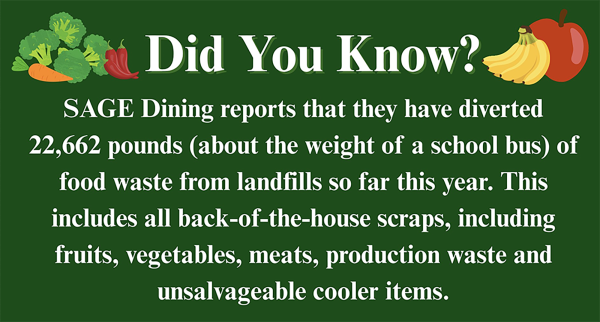
Although diners are encouraged to use plates, Hillary Whiteside, General Manager of SAGE Dining, reports that 16,100 containers have been used since the beginning of this school year. Guzman said that limiting the use of to-go containers is an opportunity for improving Hockaday’s impact daily, for students, faculty and staff alike.
“Every little piece that we try to do to help the environment actually does help,” Guzman said. “It impacts not just us locally or nationally; climate change has a global impact. What we do here can affect someone all the way across the world, and I believe people need to be conscious of that.”
Guzman applauds student involvement in climate-focused student groups such as the Environmental Board or Social Impact clubs. That being said, he warns students to plan for the longevity of these student groups.
“What is important is that you, the student body, will drive this type of change,” Guzman said. “But there has sometimes been a lack of follow-through. We’ve had members of the student body try to drive change, but the question becomes: who picks up the mantle when those students graduate? There isn’t always someone continuing the work they started.”
Another way to increase environmental awareness and activism, Guzman explains, is through the education of younger generations, a sentiment that is deeply reflected in Hockaday courses and Social Impact opportunities.
“Education is critical and can have a huge impact,” Guzman said. “Long-term environmental change depends on habits formed early and reinforced consistently. The question is: how do we continue to educate the community to understand that the little things they do every day have a cascading effect on the climate? Choosing to use a reusable plate instead of a disposable one, or selecting to print double-sided instead of single-sided, or not printing at all. Those small decisions, when accumulated across an institution of more that 1,100 students and the supporting faculty and staff, have a meaningful impact on both the environment and the finances of the school.”
For senior Megan Li, co-president of the Social Impact Compost Club, composting is a quick and easy way to help the environment. Every day, Li and other club members collect their compost bins located around campus and repurpose the waste as fertilizer for the Lower School garden.
“Our main mission is to make people aware that they can make a difference, even at such a small level, like making the choice to throw their food away in these bins instead of a trash can,” Li said. “Even going the extra mile to do that, it really does make a difference.”
Through education and hands-on activities, Li encourages others to be more aware of their daily choices that have the power to impact the environment significantly over time.
“I’ve really seen how small actions can make big change,” Li said. “A lot of times, climate change is viewed as something that’s too big or that we can’t really resolve. But even daily actions that may seem very small add up, and every single person can help minimize their impacts and their footprint.”
Human Harm
To identify and improve environmental impact, individuals and organizations must first define what they are working towards. Dr. Brendan Lavy, associate professor of Sustainability Science at Texas Christian University (TCU), said that sustainability goes beyond environmental protection.
“It is about social equity,” Lavy said. “And it is about economic stability.”
Lavy studies sustainability metrics, the quantifiable indicators used to measure an organization’s environmental impact. They differ by category but share a common goal.
“There are so many different metrics out there in terms of sustainability, but the important thing is measuring progress,” Lavy said. “And the other thing about the metrics is it’s a planning tool.”
Lavy points to Sustainability Tracking Assessment and Rating System (STARS), a framework for colleges and universities to measure and evaluate their sustainability. STARS tracks everything from academics and operations (including waste production, greenhouse gas emissions and energy consumption) to student and faculty engagement. Metrics like STARS enable organizations to gather data on their sustainability performance and formulate effective plans.
“If we’re not meeting our goals, we can go back, and we can assess,” Lavy said.
He encourages individuals to engage in similar types of reflection on a smaller scale. When lecturing on Green Economics, a model for achieving sustainable economic growth, Lavy asks students to examine their consumption habits and justify their purchases.
“What I’m trying to get at is this idea of conspicuous consumption,” Lavy said. “Conspicuous consumption is when people are purchasing certain goods to project particular identities or images within a society.”
Today, eco-conscious shopping is a popular practice that carries its own social signaling. According to a 2024 survey by consulting firm PwC, 80 percent of consumers say they are willing to pay more for sustainably produced or sourced goods.
Jessie Crowley, Upper School science teacher, reminds students of the influence they wield.
“You have a lot of power as a consumer,” Crowley said. “If people aren’t willing to buy products that are not sustainable, then the corporations can’t make money anymore.”
Unfortunately, some corporations profit by preying on this knowledge. Greenwashing is the deceptive advertising practice of portraying a company, product or service as more environmentally responsible than it truly is.
“It can be more about marketing than measurable progress,” Lavy said. “They’re not making any kind of meaningful changes to reduce the company’s actual environmental impact.”
Lavy warns consumers to be wary of misleading buzzwords and brands that lack substantiated evidence.
“It can be easy for consumers to see something that’s labeled ‘natural’ or ‘clean’ or ‘eco-friendly,’” Lavy said. “And you’re like, ‘Oh, that’s good. I’m going to make that purchasing choice because the label clearly says that it’s natural.’”
He said third-party verifications like certified organic, Fair Trade, the Forest Stewardship Council (FSC) and B Corps are more reliable metrics for sustainability. In the absence of rigorous metrics, he urges consumers to research the validity of companies’ claims or forgo the product entirely.
“Reducing is one of those key things that’s at the top of the hierarchy of the R’s,” Lavy said, referring to the famous “reduce, reuse, recycle,” waste management tip list. “The other thing that I would be remiss if I didn’t say is just refusing things.”
The need for greater sustainability is urgent: according to the World Health Organization (WHO), climate change is expected to cause 250,000 additional deaths per year between 2030 and 2050 due to disease and heat. Lavy said that the problems extend far beyond global warming.

“It’s not just climate change; it’s biodiversity loss, it’s pollution,” Lavy said. “All of those things are measurable realities studied by scientists.”
A recent report from the United Nations Environmental Programme (UNEP) envisions Earth in 2050: extreme heat will affect 9.2 billion people; the world will lose 1 million square kilometers of forests; one-third of the population will face water stress; and the Amazon rainforest may wither into a savannah.
“I think we’re getting close to that point where it’s going to be difficult to turn it around,” Crowley said. “And we have the tools and the brains and the technology to do it. So why aren’t we?”
In her AP Environmental Science class, Crowley teaches about geologic time and how the environment allowed humanity to evolve, then delves into population growth and its environmental ramifications. She leads students to question how human behavior impacts the planet.
“How are we using the land?” Crowley said. “How are we abusing the land? And what are the better ways that we can use the land and still all live in harmony?”
Maintaining equilibrium (a dynamic state of balance within an ecosystem) is a major focus for Crowley, and one that she advises students to consider carefully.
“The systems that are at play have to be in balance in order for us to continue on and for life to evolve,” Crowley said. “Your generation and your kids’ generation, your grandkids, are the ones that are going to have to deal with the mess.”
Youth are starting to take this warning seriously: 85 percent of young Americans are worried about climate change, according to the medical journal The Lancet. Now, they must channel that worry into sustainable action.
“Sustainability is not a trend,” Lavy said. “There are very real environmental limits that we’re pushing against.”
How green are you?

There was an error. Please try again.
8 Total Questions