
























Nadia Guevara – Balancing Grief and Celebration
Senior Nadia Guevara thinks it’s very important to have an inclusive community to turn to when grieving.
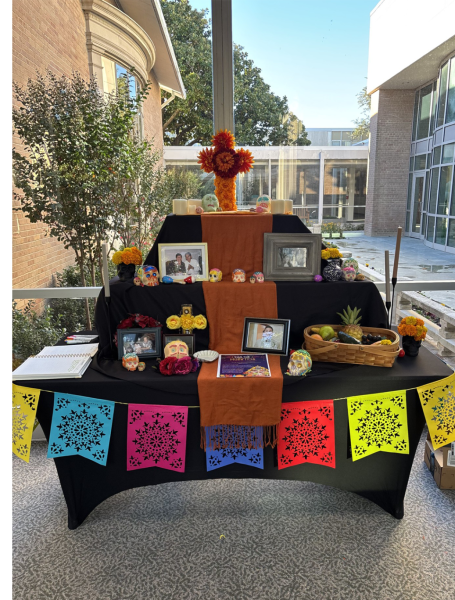
This October, LHSU set up a grief table outside Biggs Dining Hall to mark El Día de Muertos, or Day of the Dead. Guevara, Latin Hispanic Student Union (LHSU) chair, said the goal was to educate and show others how their culture grieves and honors the lives lost.
“I think that having set rituals or ceremonies when you lose someone is helpful because there’s a community and tradition to fall back on,” Guevara said. “It gives you stability that you know will always be there when you’re dealing with something difficult.”
Guevara said in her family’s culture, grieving goes together with celebration rather than sadness. Often, they find ways to celebrate life as they honor the dead. In the same manner, she finds positivity in change that may seem difficult in the moment and realizes the hidden blessings they may bring.
“Day of the Dead is a huge celebration in terms of honoring somebody’s life,” Guevara said. “In Latin and Hispanic culture, death is not viewed as something quite as sad as it is in some American cultures, and it’s more something to celebrate often. To me, it’s more important to celebrate the life that someone did live, and that’s such a healthy way to deal with grief effectively.”
Guevara said she believes prayer and empathetic thoughts can help in the healing process.
“In my family’s culture, there’s something called a novena, which is basically a nine-day prayer where you congregate at that family’s house and pray for them,” Guevara said. “There’s lots of food and reflection on good memories but also being that community for the person who is grieving. You don’t have to figure out how you’re going to get through it when you have people surrounding you in hard times.”
Guevara finds that feelings of sadness and deep emotion can be magnified by family memories that are made in the holiday season, forming new traditions can be the most difficult because it means letting go of the old and creating the new.
“Holidays are a time that you notice what’s missing,” Guevara said. “You still are with your family, and you are still together, but it looks a little different. Especially for those first few holidays that you spend, you can really notice what’s missing, whether it’s a person or a place or an idea, because that normalcy was disrupted.”
Guevara said she hopes to shape people’s views on grief by sharing her culture and the significance of Dia de Muertos. She said students can grow stronger and more empathetic by supporting one another and learning about cultural approaches to grief.
Ellen Kaney-Francis – Coping with Grief
As excitement buzzes around us this holiday season, grief can be difficult to cope with. Upper School counselor Ellen Kaney-Francis explains the workings of grief, its effects and tools to aid and guide anyone in the community who is currently processing grief.
“[Holidays, birthdays and other milestones] throughout the years are just naturally those times when you are reminded more than ever of the people or things that you are missing,” Kaney-Francis said.
According to the Cleveland Clinic, grief is the experience of coping with loss. Grief can accompany any event that disrupts or challenges our sense of normalcy, including the loss of connections that define us.
“Grief [is] considered a form of chronic stress that is very taxing on your body,” Kaney-Francis said. “[People] who are grieving [tend] to experience a lot of fatigue and a lack of motivation.”
Grief can conflict with any sense of joy that is experienced. This feeling is exacerbated during the holiday season as more celebrations take place.
“People commonly struggle with the belief that they’re not allowed to be happy again, especially if they’re grieving the loss of a loved one,” Kaney-Francis said. “There can be guilt that [your] loved one is gone, and [you] shouldn’t be enjoying [the] things around [you].”
Although feelings of self-blame and isolation, such as guilt, anger and sadness, can be overwhelming, the first step is allowing yourself compassion and time to experience your emotions as they arise.
“[Give] yourself the space to cry or journal or rant, whatever you need to do, but then also allow yourself those opportunities to feel like you again, to stay engaged in the present, to enjoy what’s around you,” Kaney-Francis said.
However, as grief can linger for longer periods than desired, you may wonder when these overwhelming feelings will subside.
“I think it evolves over time,” Kaney-Francis said. “It’s different for everyone. It’s natural that people put timelines on themselves to say I ‘should’ be done feeling this way by a certain time, and unfortunately, we can’t set [a] prescriptive time.”
Despite the uncertainties of the grieving process, Kaney-Francis emphasizes the importance of reaching out for support and confronting and coping with emotions as they arise.
“It’s normal to hit a point where you feel like you’re not allowed to talk about your loss anymore—and maybe someone has even implied or said that to you.” Kaney-Francis said. “You need and deserve an outlet for however long you need it. Your safe person might be a peer who can relate to you, a family member, a teacher, a faith leader, a coach, or a therapist.”?
Ultimately, there is no set process for grieving. However, reaching out and allowing yourself compassion is the first step towards moving forward.
“You are allowed to live,” Kaney-Francis said. “You are allowed to continue your life. You’re allowed to feel good, even though you’ve experienced something hard.”

Mia Temple – Navigating Grief in New Contexts

Grief for many during the holidays can be sadness surrounding loss that’s not death. This can include changes in relationships or moving. According to Psychology Today, “Grief is about finding yourself in a time of suffering and figuring out a way to make sense of your life when nothing makes sense.”
Senior Mia Temple will celebrate the holidays with her family in a different way this year. She is learning how to navigate these new circumstances.
“This is going to be the first year that we’re going to celebrate the holidays when my parents are living in two separate houses,” Temple said. “Last Christmas, we still had Christmas all together when my parents lived in one house, but this Christmas, it’s going to be at my mom’s house. My dad is taking my sister and I down to Japan over Thanksgiving, which is going to be fun, but it’s different.”
Temple’s parents’ have been divorced for two years and her definition of normalcy for her life has changed.
“It’s easy if you have divorced parents to feel like your parents’ house isn’t yours or like you are living with a roommate,” Temple said. “At first at my dad’s house, we never really had dinner together and we were all in our separate rooms.”
Yet, over time, her family adapted and started doing the “little things” that helped them continue to connect even throughout this time of change.
“I think it’s important to keep those family traditions going, like having dinner together on the weekdays and talking around the dinner table,” she said.
Grief is not a linear process, and feelings of frustration or anger can arise at different times.
“I don’t really get sad about it,” Temple said. “Usually, you get frustrated, which I feel is a harder emotion to deal with because there’s just nothing I can really do about it.”
Yet, Temple decides to focus on what she can change in her own life.
“You’re used to having all of your family around you during the holidays and when going through changing circumstances that is not the case,” she said. “I usually just try to think about what is in my control and what is out of my control.”
Throughout these last two years, Temple has realized that she is stronger than she may think.
“I’ve learned that I’m more adaptable than I think I am,” Temple said. “At the beginning, I was like ‘Oh my gosh, what do I do here?’ But kind of as it’s gone on, I’ve learned to roll with the punches and take what I’m given.”
When grief flips the world we know upside down, we can change our perspective on how we see it and adapt.
“I am just as happy or even happier right now than when my parents were not divorced, so I feel like it’s all about perspective,” Temple said. “If you look at it from a standpoint of helplessness, you put yourself in a place where you have to be sad. But if you power through it, you can overcome it.”
Grieving memories – Upper Schooler
Another Upper schooler has seen the impact of grief on her life recently.
“I have grieved the loss of both of my maternal grandparents who passed away in 2020. Also, I am currently moving from my childhood home, so I’m grieving all the memories I made there,” she said.
Often with grief, there are people who avoid the sadness that can come with it, those who feel overwhelmed with emotion, or people in the middle. It’s hard to know how to feel when there’s really no right or wrong or any moral line to balance on.
“It’s important to not suppress your emotions because they’re all important for the grieving process. It won’t all go away after a certain amount of time. You can feel completely fine one day and feel sad another day,” she said.
Grief can be a time of growth for many people. It can completely change our perspective on life.
“Grief makes us realize that most things in our lives aren’t permanent. It helps you to appreciate what you have and learn to live in the present,” she said.
Grief typically is not straightforward. There’s a sense of duality one must hold with their feelings, and often we feel two things at once.
“I’ve also learned to appreciate every moment, even times where life isn’t perfect, because someday I’ll look back on these times and miss them,” she said.