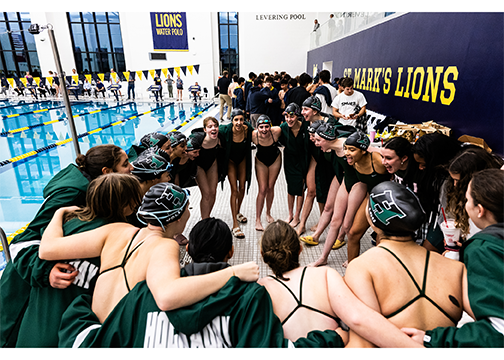


































Naturally, athletes crave progress; however, some forget that failure is still a step forward. Whether it is due to parental pressure or an internal drive to succeed, the lines between athletic performance and self-worth begin to blur.
Sophomore Abby Crook, a cross-country and track athlete, believes running gave her purpose and edified her will to persevere. Originally, Crook got into running as a way of connecting with her older sister and bridging the disconnects the age gap between them. She hated running and cried frequently during preseason, often considering quitting. However, she wanted to prove to herself that she could do hard things and not let her sister down.
“I can’t imagine my life without it,” Crook said. “I think it teaches me a lot about how you have to work really hard to get what you want.”

Every day she tackles balancing her love for her sports and not letting the pressures consume her. She acknowledges that running hurts and it takes a strong sense of self to push through regardless. The competition on the track can feel overwhelming, and Crook coaches herself out of incessantly checking her opponents’ race times. When she gets on the track, she reminds herself that at the end of the day, the races she prepares for solely revolve around her; even when someone else is ahead, the fact she is on the track is a win.
“Running is such a mental sport, and it hurts so much when you’re doing it,” Crook said. “It has taught me that no matter how much something hurts, you’re going to be better after.”
Competitive athletes like Crook struggle to address both physical prowess and their mental health as they progress. Metrics like “run time” and “goals scored” often start to feel like character flaws rather than athletic missteps, especially when someone else is performing better.
“I make my (personal records) PRs my entire identity,” Crook said. “If I don’t run well, I’m not happy with myself.”
Junior Jameson Dondero, a fiercely devoted rower, feels the same pressures of achieving new PRs. Rowing is one of the only sports with published PRs, creating the isolated pressure that one athlete will always quantifiably be better than another. Dondero recognizes that athletics constantly require change, and the only way to rise in ranking is to adapt.
“I had such a mindset shift, because in sports there is no perfection,” Dondero said. “You just strive for the best you can and be one percent better every day. That [mindset] helps with my goals and how I approach things.”
Much like Crook, Dondero discerns that as her sports grew more competitive, her self-identity became increasingly tied to her sports performance. Rowing seized her every waking moment, her obsession leaking into every conversation she held with her peers.
“I had this problem in my underclassmen years where I talked too much about rowing,” Dondero said. “We had this grade-wide ban on talking about sports in general because everyone was like, ‘you guys talk too much about your sports.’”
When wins feel like such successes, losses often feel like exasperated failures.
“When I had [one] bad situation after [another] bad situation, I went down into a spiral,” Dondero said. “It does take a lot to get out of that, but whenever you do, then you’re aware and not going to let that happen again.”
Despite the obstacles, she feels like rowing is an integral part of her and she would fall apart without it.
“I look forward to being with the people on the team and having a purpose,” Dondero said. “When I’m in the workforce and don’t have that anymore, it’s going to be hard.”
Varsity Coach Rodney Skaife also worried about a life without sports until his fear came to fruition. At one point during his early soccer and golf career, he had to cope with a catastrophic injury that took him off the field. He held a leadership role in almost every team he played on which served as a coping mechanism for him, but the journey without it burdened him greatly.
“In high school, I fell on fire and burned the back of my legs and had to have skin grafts,” Skaife said. “I hated it, because I was captain of most of my teams and had to sit out.”
Rather than pushing himself past his limits and trying to play, he learned the power of patience. He continued to hone his love for his sports, even despite his injury. Through the trials and errors of his athletic career, Skaife learned what obstacles student athletes face. He stresses that the hardest part of coaching is reminding his athletes that their goals have to be achievable in order to protect their mental health. Even when the pressure comes from parents, he advises Hockaday athletes to focus on their own goals and aspirations.
“Where people get in trouble is when [pressure] becomes internal, and they look at themselves too harshly,” Skaife said. “It’s usually because of unrealistic expectations.”
When looking to the future, he hopes his athletes will obsess over the love of their sports rather than their quantified performance.
“We’re all guilty of it, that you become result-based and focused, because that’s all you hear,” Skaife said. “You don’t hear about the team that lost every game, but everybody loves it. We have somehow got to get enjoyment as a priority.”
Skaife also believes that fixating on a singular sport can curate toxicity.
“I think there’s a huge problem at the moment of people focusing on one direction where [athletes] are not seeing the transfer of skills from sport-to-sport,” Skaife said. “If you’re doing well somewhere, the likelihood is you can do well somewhere else too. You just need the same exposure.”
Varsity Lacrosse Coach Molly Ford agrees with Skaife that playing a sport means adapting. Ford tore her ACL right after qualifying for the US women’s team and had to drop out. However, her love for lacrosse grew the longer she could not play and after returning seven months later, she made the team again. In her eyes, a good work ethic breaks down obstacles.

“[Sports are] figuring out how to work hard and see your goals come alive,” Ford said. “Achieving your goals is huge and is something that you can use in real life after sports are over.”
Despite the duality of the good and bad pressures sports bring, Ford urges Hockaday athletes to remember that they are strong, resilient young women, and can always come to their coaches. She believes in the celebration of successes instead of the miseries of mistakes. Most of all, she insists that athletes remind themselves to love what they do.
“Every day is a different day for every player,” Ford said. “I think being able to get out on the field and enjoy [playing] helps their mental health. I think there are times where expectations can be a hindrance on mental health.”