


































Grief, justice and resilience take center stage in this year’s spring play, “Women of Lockerbie.” Performed by the Upper School Acting Lab Class, the play is scheduled to take stage on April 23rd and 24th.
Inspired by the real-life aftermath of the 1988 bombing of Pan Am Flight 103, “Women of Lockerbie” follows an American couple who travel to Lockerbie, Scotland in search of answers after losing their son in the attack. There, they encounter a group of local women determined to recover, wash and return the victims’ clothing to their families as an act of dignity and compassion. As tensions rise between grief and justice, the women’s quiet determination becomes a powerful symbol of collective healing.
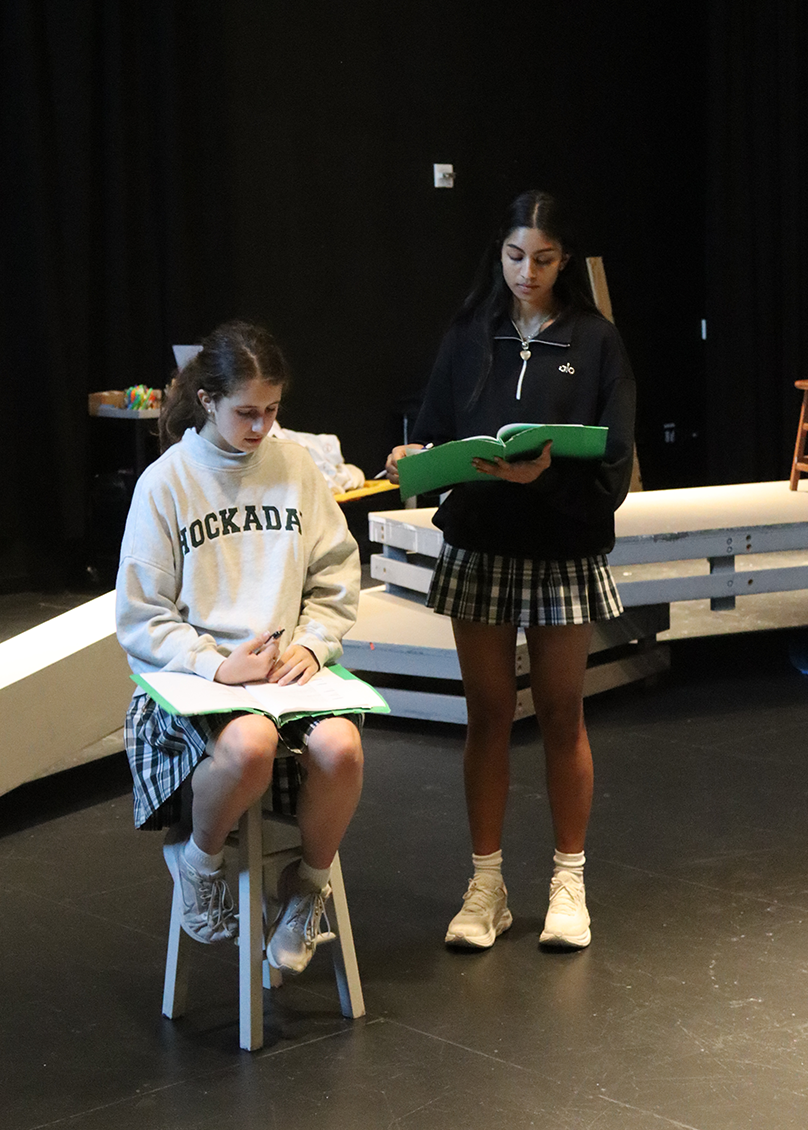
Junior Avika Guttigoli plays Bill Livingston, the husband of a grieving mother. As his wife spirals under the weight of their loss, Bill must remain emotionally grounded, grieving quietly while holding his family together. Taking on such a layered role reshaped Guttigoli’s perception of grief.
“After understanding Bill and his wife’s experience, I began to realize that grief can’t be confined in a specific order of five stages,” Guttigoli said. “It ebbs and flows depending on each person and their situation.”
To authentically portray their characters, the cast conducted extensive dramaturgical research before rehearsals intensified. The play builds toward catharsis, the emotional release that allows audiences to process complex emotions. To reach that level of emotional depth, Guttigoli immersed herself in research and character development.
“We did dramaturgy work as the research backbone of the play,” Guttigoli said. “We developed a backstory to each character, which helped put ourselves in their shoes and understand how they lived prior to the accident and what shaped their reaction to the tragedy.”
Sophomore Caroline Hayes was cast as George Jones, an American bureaucrat tasked with managing the wreckage and personal belongings from Pan Am Flight 103. Though fictional, Jones represents the cold government bureaucracy that prevents the grieving women from retrieving their loved ones’ clothing. To understand the motivations of her character, Hayes focused on empathy rather than judgment.
“Understanding your character requires you to sympathize with them and see things from their point of view,” Hayes said. “As an actor, you have to be able to agree with them because if all you do is judge them, then that’s going to come through when you’re performing it.”

Jones undergoes significant development over the course of the 40-minute play, shifting from refusing to return the clothing to eventually allowing the women to honor the victims. The largest challenge for Hayes lies in authentically portraying this transition with just two on-stage scenes.
“A lot of George’s character arc happens offstage,” Hayes said. “I have to figure out almost an internal monologue for my character while he is offstage and then show how he’s been impacted when he returns.”
“Women of Lockerbie“ was written as a Greek tragedy, a structure that Hayes says deepens the emotional weight and lyrical beauty of the production.
“One of the beauties of the show is that it is very poetic,” Hayes said. “There are choral odes that discuss broader themes, like grief, hate and faith, that remind us to find a path back to love, even if it requires confronting grief.”
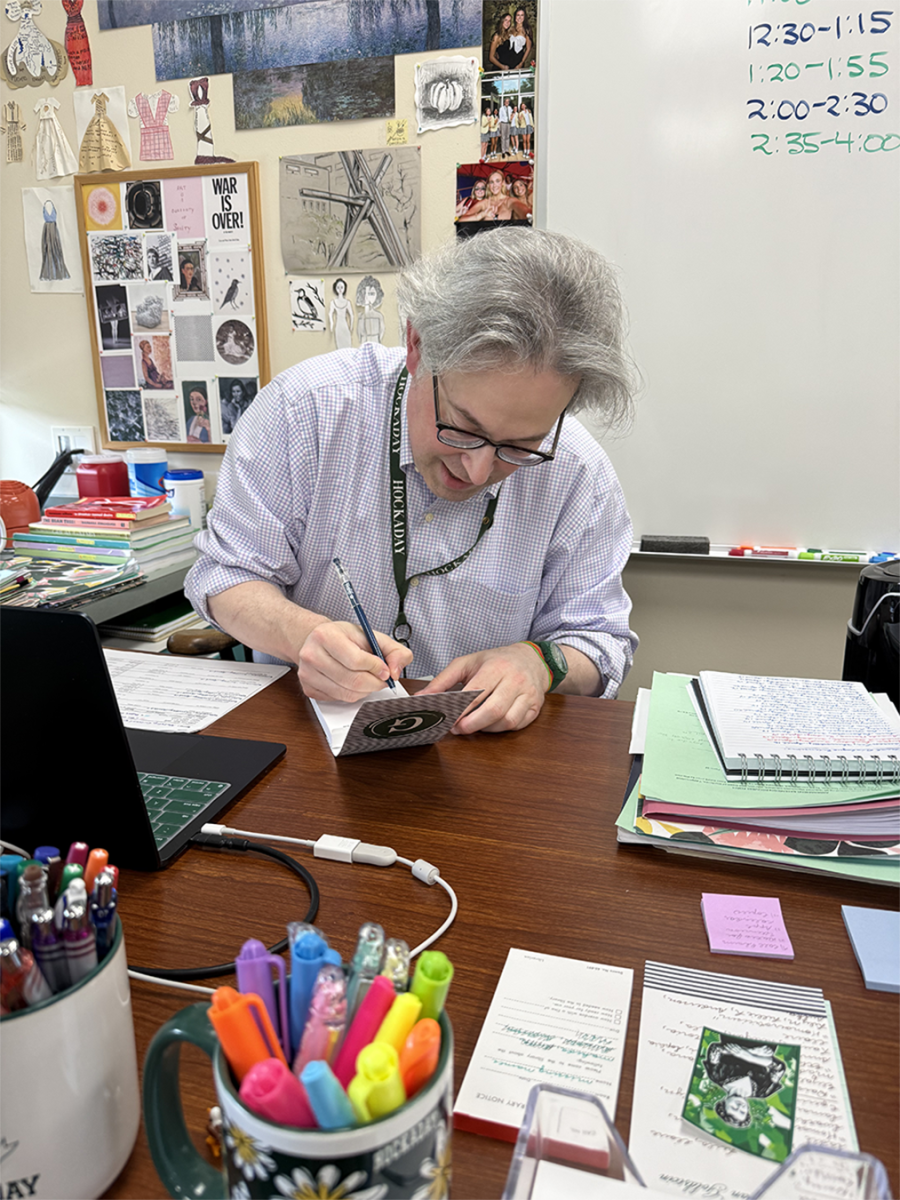
The director of “Women of Lockerbie,” Upper School drama teacher Michelle Greene, recognizes the enduring power of the play’s reminder to choose compassion and unity in the face of adversity.
“Regardless of the tragedies that we may experience, the idea of coming together for a cause is timeless,” Greene said. “Looking past our differences and seeing what we all have in common, which is love and support for each other, is the best way to move forward.”
For Greene, one line in particular captures the heart of the production’s message.
“One of my favorite lines in the play is ‘Hatred will not have the last word in Lockerbie,’” Greene said. “It shows how we can do things as a community when we come together with love in our hearts instead of hatred.”