





















When gunshots rang out in a California home, Lesley Hu turned heartbreak into activism. Hu founded Pierce’s Pledge, a non-profit organization with a mission to protect children during custody disputes by facilitating safe and temporary third-party firearm storage. After the tragic loss of her young son Pierce, Hu vowed to protect the most at-risk demographic for gun violence: children.
“I will stand in front of any single person to protect any child, because children deserve better than that,” Hu said.
In the US, firearms are the leading cause of death for kids ages 1 to 17.
Hu and her ex-husband divorced five years before he killed both Pierce and himself. Hu fought legal battles with her ex-husband over vaccinating their son until a judge ruled in Hu’s favor, sending her ex-husband deeper into a spiral of conspiracy theories.
On Jan. 13, 2021, Pierce spent a weekend with his father, unknowingly walking into devastation. The nine-year-old boy who adored travelling with his mom, watching “Top Gun”, playing with toy robots and making his friends laugh, died at the hands of his father. Pierce was shot directly through the heart before his killer ended his own life.
Pierce’s sudden death shattered Hu.
“I didn’t leave the house for a month,” she said. “I went from choosing what to cook Pierce for dinner to deciding if I bury him or if I cremate him.”
Hu’s significant other at the time kept her going, encouraging her to travel.
“It was really hard to move around a lot because everywhere I went I didn’t have Pierce, but being home was even harder,” Hu said. “At home, with the trauma and the pain, I was reliving Pierce’s murder over and over and over again.”
An essential part of Hu’s healing journey was channeling her pain into making a difference. When her close friend, family law attorney Monica Mazzei, began asking her clients to lock away their firearms during divorce, Hu was inspired to create Pierce’s Pledge.
“Advocating and building this pledge actually got me through a lot of the sadness,” Hu said.
She does not aim to infringe upon the Second Amendment; rather, she promotes temporarily relinquishing firearms during periods of distress.
The website for Pierce’s Pledge features a petition for family law attorneys to sign, requiring their clients to declare and store their semi-automatic weapons during trial. The website also includes a map where users can find gun storage facilities locally, as well as resources and toolkits for families and professionals involved with child custody disputes.
“The campaign is about talking to people about when they are in a moment of crisis and knowing when it is safer to have the gun out of the home than in the home,” Hu said.
The organization began in California, but with each individual signature, it grows nationally.
Hu holds seminars all over the country to educate others on her story and her mission. She wants young people to know that “everybody can make a difference,” regardless of age.
Hu encourages high school students to check in with their friends who may be experiencing difficulties at home.
“Don’t be afraid to ask,” Hu said. “Don’t be afraid to be that person, because that person could be the one that could have saved Pierce’s life or given him a chance.”
Hockaday students hear Hu’s plea for fearless involvement and understand the importance of engaging with issues of violence in their own communities.
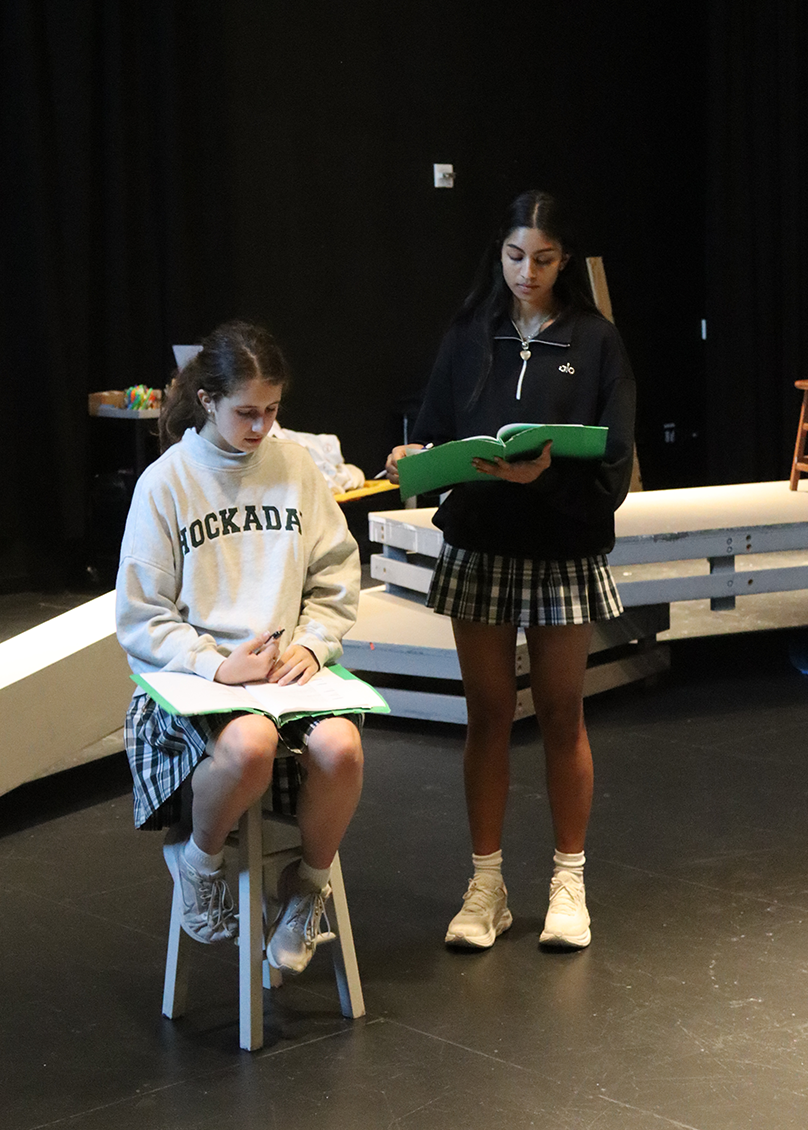
For the past 35 years, HockaDaisies have partnered with the local Genesis Women’s Shelter through consistent volunteer visits.
Senior Sara Gupta felt motivated to take action after learning that her grandmother’s nurse experienced intimate partner abuse. As president of the Hockaday-Genesis Program since her sophomore year, Gupta reflects on the experience.
“I think the most meaningful part of leading the program has been seeing how many more people get interested in it every year,” Gupta said. “People care about this cause, even if they haven’t had personal experience with it.”
The issue of family violence is especially relevant in Texas: one in three Texans will experience domestic abuse in their lifetime, which is more than the national average for both men (one in seven) and women (one in four). Genesis Women’s Shelter works to combat domestic violence, providing both immediate help and long-term support at no cost for women and children experiencing abuse.
Jenna Severson, Director of Communications at Genesis, dispels myths surrounding domestic abuse. She explains that contrary to popular belief, domestic abuse extends beyond physical violence.
“The core tenet of domestic violence is around power and control, and that can be exerted in a lot of ways,” Severson said, highlighting the financial abuse experienced by approximately 99 percent of women that Genesis serves.
Focusing on the “little wins” can make the difficult work at Genesis feel less disheartening, according to Severson.
“When you engage with your direct community, whether that is making a donation of clothes to our thrift store, joining one of our groups or just learning more about what we do, it helps things feel a little less overwhelming,” Severson said, referring to the Genesis Benefit Thrift Store. Its proceeds support Genesis programs and families, who can also shop for free there.
From its origins as a seven-bedroom shelter in 1985, Genesis has grown to encompass multiple locations, including an emergency shelter and two non-residential locations offering counseling and legal services.
Teachers drive Hockaday students to the shelter’s undisclosed location, an additional safety precaution. During their bimonthly visits, students mainly work with the children’s department of Genesis, entertaining the youth who live at the shelter while their mothers receive counseling.
“It’s really nice to be able to make [the children] happy even if it’s just for that short amount of time,” Gupta said.
Gupta notes that children at Genesis’s emergency shelter have little interaction with the outside world during their eight-week stay. Spending time with volunteers is a highlight for them.
“All of them come to the gate to say hi to you,” Gupta said. At the gate, the constant police presence and strict security requirements remind every visitor of the shelter’s purpose: to protect women and children facing violence.
Genesis professionals approach every family’s situation with the knowledge that each is unique.
“We work individually with every single woman to determine what a safety plan could look like,” Severson said.
A safety plan may involve helping a woman identify support networks or working on action steps to exit the relationship, a process which often imperils the woman. This danger is worsened by the presence of firearms.
“It’s a pretty clear correlation that when there are firearms present in an abusive household, the woman’s risk for lethality increases,” Severson said.
Both Severson and Gupta emphasize how intimate partner violence can also occur within adolescent relationships. Genesis runs an auxiliary program, Students Tackle Abusive Relationships (STAR), to educate teenagers about dating violence.
Gupta feels a duty to spread the word about all community violence. She encourages others to approach volunteer programs with a willingness to help.
“It’s part of our responsibility to raise awareness whenever we can,” Gupta said. “No one’s ever shaming you for not doing anything, but everyone’s always appreciating if you do something.”
Apart from engaging in Genesis programs, simply learning about the different types of family violence is important.
“Another way to get involved is just to get aware,” Severson said, directing interested people to explore the Genesis website, which contains educational resources and information.
While engaging with challenges, Severson maintains positivity by focusing on why her work is meaningful.
“Every single woman and child who comes to Genesis is so deserving of a healthy and safe relationship,” Severson said. “They’re deserving of joy, and to be able to be in the position where we can help bring them that is really special.”
Severson reminds high schoolers that they are entitled to the same safety and happiness.
“You deserve to be in a relationship that feels healthy,” Severson said. If it does not, Severson has a message for you: “There is help and there is hope.”
If you or someone you know may be in an abusive relationship, call or text the Genesis 24-Hour Helpline for more information or to access services: 214-946-HELP (4357)