


















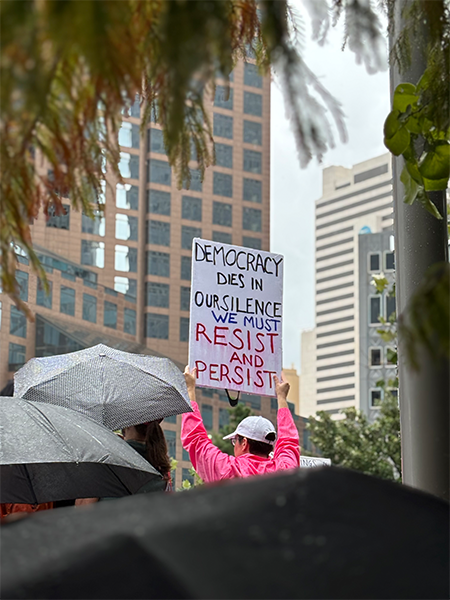
Protesting with a New Perspective
At 12 years old, my first experiences with protests were through a screen as news channels flashed images of Black Lives Matter protests and the storming of the Capitol. Every march reeked of violence and blind fury toward the opposing side, a combination so formidable that it was easier to fear than admire. I recall wondering why anyone would protest; the price seemed too high to risk, especially when so few protests result in true change. This trepidation instilled in me remained strong even as I arrived at the No Kings Protest on Oct. 18.
As a multi-racial young woman in Texas, it is easy for me to feel unheard and underrepresented by our current administration. Frustration is quick to consume the energy I must reserve for empathy and compassion, and a cynical, resentful version of myself—who I hardly recognize and am never proud to be—appears. My goal in protesting was not to satisfy or avenge this shameful alter ego but rather to pursue my timid curiosity of political activism. After months of feeling voiceless, the only option seemed to be to directly express my views and establish myself as part of a bigger community, one that shares my values, politically or otherwise. But I would never know if this group truly embodied my beliefs if I never witnessed it firsthand.
I could write about the speakers at the protest, and how their chants grew louder as a few, then a dozen, then a hundred protesters joined in. I could write about how the rain beat down on the crowd, drowning out those same chants, and yet they did not move. These anecdotes show the strength, solidarity and determination of the protest, but rather than focusing on these qualities, I would like to introduce a more surprising aspect: love.
As soon as I arrived, I was quickly taken aback by the support and encouragement displayed in my surroundings. Protesters eagerly welcomed each other, proudly showing off their creative signs and banners. They donned outfits of red, white, and blue, carried American flags with dignity and honor, and held signs reading, “I am here because I love my country.” Police men held the hands of elderly protesters as they stepped off the train, waving them off as they joined the crowd. Hints of humor lay in every direction, with one of my favorite signs reading, “So messed up, even the introverts are here.”
I learned many lessons that day. Firstly, not all change is visible. While I used to view protests that did not cause immediate reform as failures, I now recognize that some of the most important effects occur within our hearts. As each of us grapples with our own confusion of political standing and identity, we can find comfort or understanding in a community of like-minded individuals. There, none of you are alone in your pain, fear, anger or desire to speak out, and the weight you carry becomes lighter in the hands of many.
Secondly, having opposing political opinions does not define you as—nor, with equal importance, permit you to be—violent. There is always a way to be respectful and kind in the sharing of your beliefs, even when your emotions threaten to overtake all reason. To be strong without malice, to be loud without silencing others: these actions display true courage, something I can only dream of achieving one day. The ability to love through anger is an unmatched power, and that, to me, provokes more respect than any imagination I had of protests before.
I understand that protesting is not everyone’s ideal Saturday afternoon, and I don’t recommend it to be either. However, I believe that it is time to change our perception of protesting and what it means to speak out. This change, I hope, begins with stories like mine of love shown and a mind changed.
Highlighting the History of Protests
The No Kings Protest, a peaceful, liberal-leaning demonstration against the Trump Administration, occurred on Oct. 18, 2025, in over 2,700 cities around the world. According to the New York Times, the protest mobilized seven million people, a huge increase compared to the approximated five million that marched during the last No Kings protest on June 14. The No Kings website declared their mission to be “standing together in nonviolent defiance of authoritarianism and affirming that this nation belongs to its people, not to kings,” a goal they hoped to achieve through exercising their First Amendment right.
While the No Kings protest was not focused on the rights of a certain group, many of its complaints were centered around the recent actions of President Trump and the U.S. government. Among these grievances lie infringements on LGBTQ+ rights, ICE raids, the deployment of the National Guard, and tax breaks for the upper class.
Jordan Innerarity, the Upper School Dean of Students, sponsors the Young Democrats club. He said he navigates rising frustration against Trump from students.
“When we talk about our frustrations that we have, I think you have to find a way to have that civil discourse,” he said. “I can feel frustrated about what is happening in our country, , but then make certain that the first thing that I’m shooting out of my mouth is not ire or vitriol. That doesn’t get people to engage. That doesn’t lead to change.”
Innerarity emphasizes that, while protests are important to represent the people’s interests, they must remain non-violent and organized to be effective.
“Protests are always helpful. I think they’re helpful as long as they are nonviolent in nature, that there is a set goal and expectations,” he said. “I think there’s, unfortunately, always some outliers that will engage in those things problematically. But I think a majority of protests are helpful in some way.”
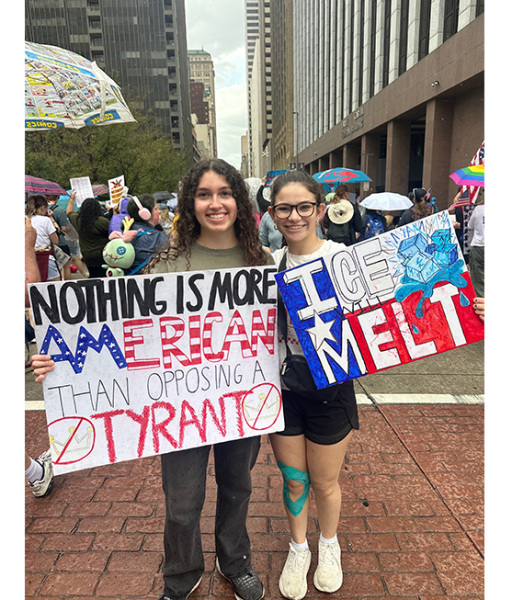
Senior Caroline Ballotta attended the No Kings Protest on October 18, an experience she describes as impactful and inspiring.
“I attended to find community and to stand up for what I believe is right,” Ballotta said. “I also wanted to contribute to a larger cause and show support in a way that felt active and visible.”
Protests play a major role in politics and democracy, Ballotta says, especially by offering opportunities for people who cannot vote to speak up.
“I think that protesting is important because it shows that people care and that change isn’t just going to happen on its own,” she said. “It reminds those in power that citizens are paying attention and won’t stay silent.”
Ballotta described the atmosphere of the protest as supportive, peaceful, and united, emphasizing the strong sense of community that she felt. Surrounded by purpose and passion, she recalls feeling hope.
“I think that a lot of people, including me, can slip into the mindset that our voices don’t matter or that there’s nothing we can really do,” she said. “But seeing so many people who are passionate about what they believe in and coming together to create change was really reassuring and empowering.”