
















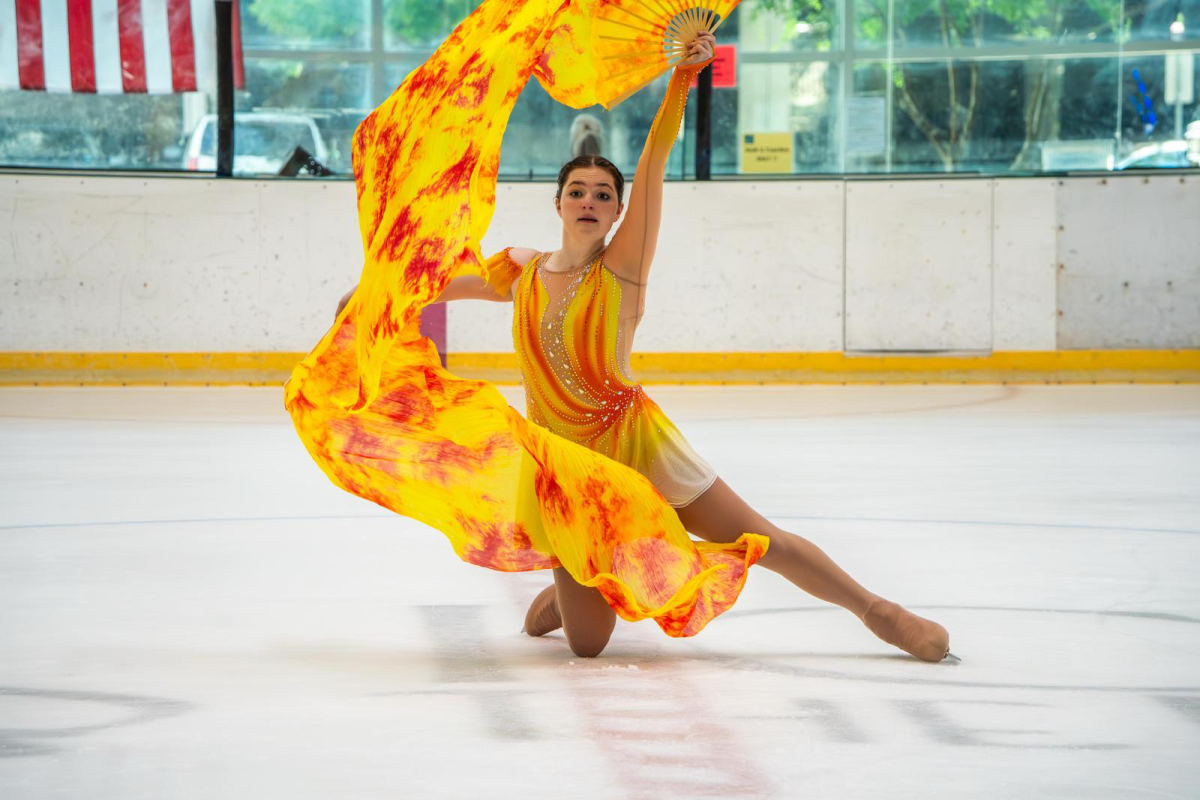
Sequins on, arms up. Applause echoes through the rink as the announcer calls her name. Senior Chloe Oeschger takes her place at the center of the icy expanse. The audience hushes as she takes her starting pose—all eyes are on her, expectant. The music begins, and the world fades away.
“Skating being such a unique sport is both a blessing and a curse,” Oeschger said. “You very much have your community, and it’s a lot of fun to get to do something that’s special, but at the same time you don’t really have anybody to talk to about it because there are fewer people who do it.”
Oeschger is among a small number of Daisies who ice skate for competition and for enjoyment.
She competes mainly in singles, skating solo and performing jumps in her programs. She skates around 15 hours a week, mostly at the Galleria ice rink, and has done synchro skating as a team, and solo ice dance, which does not incorporate jumps.
Last season, she skated to multiple songs for programs across different disciplines, including “Golden” from “KPop Demon Hunters”.
She enjoys skating because of the way it pushes her.
“It’s definitely a challenge to keep going at a jump that you keep falling on and just keep trying until you get it,” Oeschger said. “It’s almost like a puzzle, and that’s a lot of fun.”
Junior Sara Sakamoto started skating 11 years ago.
“It’s something that’s always been with me,” Sakamoto said. “Sometimes, I get motivated by thinking how proud the little me would be to see me skate today.”
Sakamoto competes in solo ice dance with the Dallas Figure Skating Club, skating every day of the week except Sunday. She skated to “Die with a Smile” by Bruno Mars for one of two programs last season, and her favorite skaters include two-time Olympic champion Yuzuru Hanyu, who inspires her through his artistry and musicality, and two-time US Nationals champion Amber Glenn, who skates in Sakamoto’s club and inspires her with her kindness and advocacy. Last season, Sakamoto competed at the National Solo Dance Final, placing fifth.
“Because solo dancing is a smaller community, even though a lot of people skate in different parts of the country, they’re more likely to see their friends [at competitions],” Sakamoto said. “All the friendships are closer.”
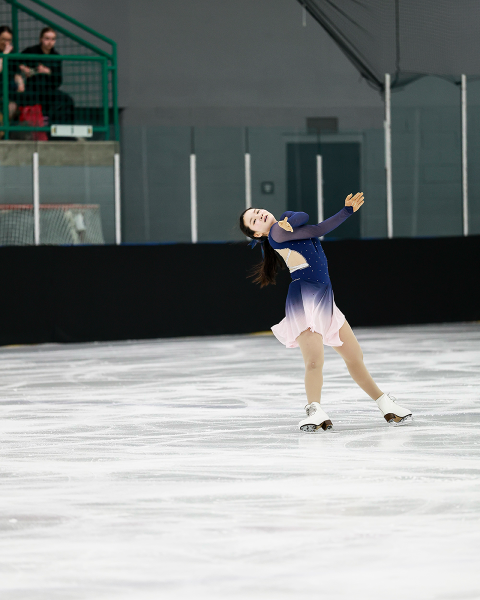
However, not all figure skaters compete. Sophomore Magic Cather chooses not to do competitions, focusing instead on learning moves she enjoys.
“I really like to learn new things,” Cather said. “I like to do it just for me in a way.”
Cather has skated for around four years, starting after the pandemic with her mom. In the past, she has competed in singles skating but loves to watch pair skaters. She skates around once a week but anticipates practicing more when she can drive.
Cather said one of the inconveniences of skating is the fact that it requires a rink.
“I feel like that makes it not as open to everyone because not everyone has the time to go to a rink,” Cather said. “I skate at the Galleria rink, and it’s busy a lot of the times, so I’ve had lessons at six in the morning before.”
Sakamoto said another challenge of figure skating is that it is not an NCAA sport.
“[Skating] can improve your resume a lot, but you can’t get recruited to colleges for it,” Sakamoto said.
Though competitive skating is not weighted the same as many other sports in terms of college applications, it includes many of the same challenges.
“It takes up a lot of time, especially if I have to go to a further rink,” Oeschger said. “This morning I had a lesson in Allen, so it was an hour coming back.”
Contrary to common misconception, figure skating is not exclusive to elite and competitive skaters. Anyone can be part of the community through various disciplines and divisions that have made the sport more accessible to a wide variety of people.
“There’s so many [disciplines] that basically anybody can skate now,” Sakamoto said. “It’s really fun to meet new people, and everybody’s having fun.”
Oeschger agrees that figure skating has much more depth in its community than most people assume.
“People tend to think that you have to be a certain kind of person to skate, and that’s not really true,” Oeschger said. “There are people who just do it for fun, there’s adults, there’s a much bigger community than I think people realize.”