














Enlightening English
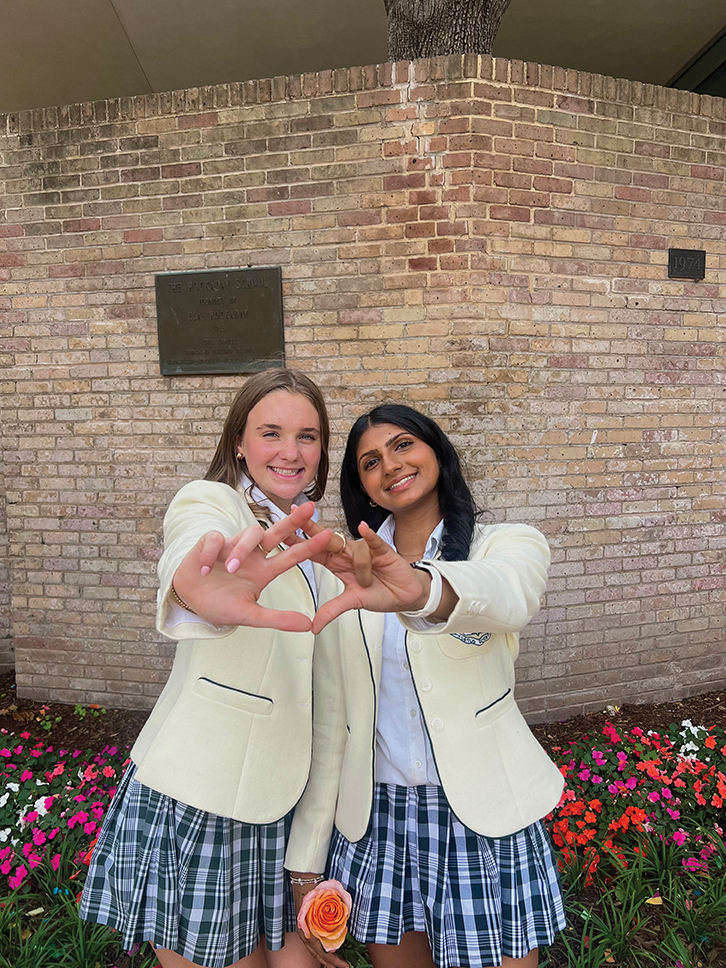
Weaving through the Hockaday Archives, seniors Fendley Obert and Gray Damonte comb through yearbooks with a single goal in mind: to identify a meaningful friendship in Hockaday history to research.
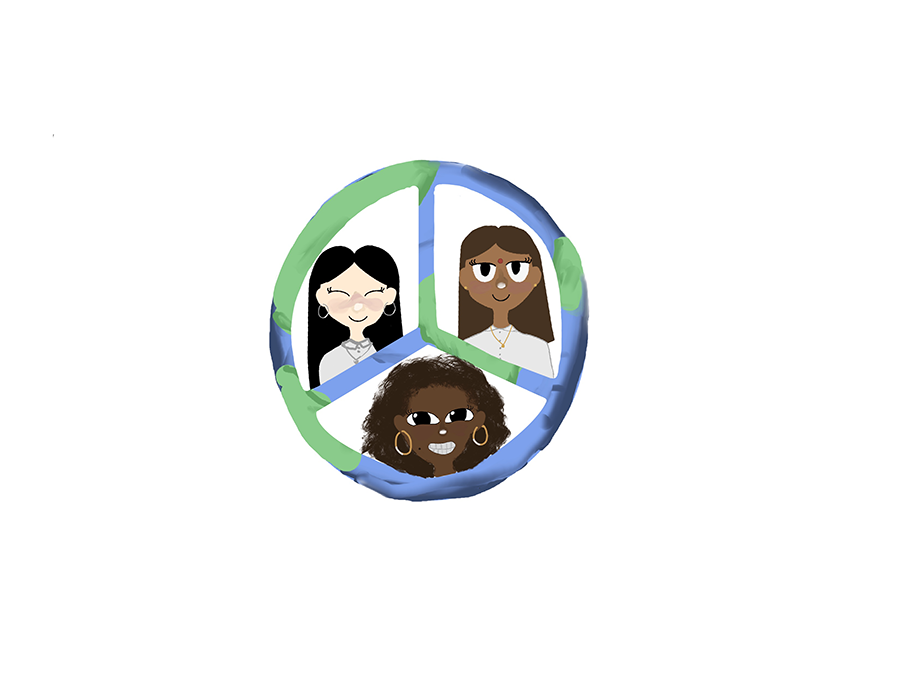
A new English Honors and Social Impact senior seminar, “Female Friendship in Literature,” taught by Upper School English teacher Dr. Claire Cothren, examines prominent female friendships in literature and classic films to analyze the qualities that shape long-lasting friendships.
After completing this course, Obert said it has influenced her gratitude for her friendships.
“The class really made me appreciate the friendships that I have and how the people around you shape who you are,” Obert said. “You’re looking at it through literature and how relationships impact people through the female friendships. I can see that you really are a mixture of the people you surround yourself with and how important those people are.”
For the final project, students worked with a partner to identify friendships in the archives, reach out to those alumnae and invite them to share their stories. The senior partners discovered Sarah Wilson ‘99 and Meredith Waters ‘99 through a yearbook ad from their parents that read it is “always friendlier with two.”
“It was really interesting to see how they were friends since kindergarten, but they weren’t always at Hockaday and to see how Hockaday brought them closer together,” Damonte said. “I related it with Fendley because we weren’t always at Hockaday together, and it was really nice to see them talk about how their friendships from Hockaday have stayed with them.”
After interviewing both alumnae, Obert and Damonte collaborated on how best to represent this friendship.
“They talked very thematically throughout the interview, and it was something you can’t quite articulate in a biography since it wasn’t a story, but more what each other meant to them,” Obert said. “They gave us six pictures, and we wrote a poem about each picture representing a larger theme to their friendship. We also made a mural of their friendship and talked about the analogy of an invisible string that connected them throughout their lives.”
While the project felt daunting at first, Obert and Damonte ultimately found it to be an incredibly rewarding process.
“So many things in this class felt impossible when we got the paper, and they all turned out so much better than expected,” Damonte said. “It’s special to see these photos of past friendships and then see myself, and I’m part of this too.”
During the final class period of second semester, the Female Friendships students hosted a poem party where they read original poems about friendships that hold significance to them.
“We wrote a poem to our best friends or a friendship that really impacts us,” Obert said. “I think that was really special because I think it’s sometimes hard to tell the people you care about how much they mean to you.”

Nearing the end of her 14th year at Hockaday, Obert feels especially moved by this project.
“I think there were a lot of people who had some light tears during it, but it was a really special moment that I had,” Obert said. “It felt very cumulative of what I’ve learned throughout the entire semester of how much this friendship means to me.”
Obert is thankful for the way in which Female Friendships made her more appreciative of her friendships.
“I think this was probably the most impactful class I have ever taken, and it imparted something very deep about the power of who we interact with and the power that we have to shape the people that are closest to us,” Obert said.
Extraordinary Engineers
From designing robot arms to helping Lower Schoolers improve visibility when using microscopes outside, Upper School engineering students have the opportunity to embrace innovation and design to enhance their daily lives.
Taught by Upper School Science teacher Dr. Marshall Bartlett, “Engineering Design, Manufacturing and Human Progress” allows students to study manufacturing technologies to create objects that address challenges. Using a computer-aided design program (CAD) and the robotics lab, students bring ideas to reality.
“The students are learning to use a CAD program called Onshape,” Barlett said. “The projects are the application of the ideas that we talked about in the course, and the use of CAD brings it all together to make actual things.”
Bartlett allows students to grow as engineers by leading them to design solutions during the projects.
“They’re free to design their solution in any way that they want, so everyone’s device looks a little different from someone else’s,” Bartlett said.
Each semester, Bartlett incorporates two major projects: a simpler design and a more complex, multi-part build as students’ skillsets progress.
“The first project is a relatively simple, single object that you have to design,” Bartlett said. “The goal of the second project is to increase the level of complexity, where these are now multi-part projects.”
During the fall semester and last year, Bartlett’s class had the opportunity to partner with Lower School students to design devices that improve microscope viewing, using CAD, 3D printers and laser cutters to bring their vision to life.
“The students worked on designing a device that would help our Lower School students see the screen of a microscope better,” Bartlett said. “Last spring, we took our designs over, and the Lower Schoolers took us into the garden and showed us the types of things they collect, how they use the microscope and then they were trying out each design,” Bartlett said. “We actually had the students give direct verbal feedback and vote on which ones they liked most.”
In order to bring their ideas to fruition, the students use CAD and 3D printers.
“Some students have also used the laser cutter or other things,” Bartlett said. “My objective is to have this ladder-stepping of projects where they become increasingly complex as the semester goes on.”
When assigning projects, Bartlett establishes a set of requirements for his students to meet while leaving room for their creativity and unique ideas.
“There is a rubric that they’re trying to meet as they design their solution, so that’s essentially like if you were an engineer in real life and you went to a client,” Bartlett said. “Then, within the bounds of that criteria, they are free to design in any way that they want.”
Over the course of the semester, Bartlett notices significant increases in skills and capabilities among his students.
“I see them improving enormously in their confidence, particularly in their ability to realize their designs,” Bartlett said. “As they move on to the second project and their skillset has increased, their confidence in using the software has increased. I see them having a lot more freedom in their design to find ways to make their vision of what the solution should be a reality.”
For the more complicated projects, students have designed robot arms, personal light sources or paper-folding devices depending on the semester.
“The paper-folding project was inspired by a YouTube video,” Bartlett said. “What impressed me was how diverse the solutions the students came up were with that project. The project was fairly open-ended, where they had to feed [the device] a piece of paper, and it has to make four unique folds in the paper.”
Bartlett hopes more students will be drawn to it even if they aren’t interested in becoming engineers.
“Regardless of whether you’re going to be an engineer in the future or not, every one of us interacts with dozens and dozens of things every single day that are manufactured to make our life better, easier and simpler,” Bartlett said. “The course will help anybody have more of an appreciation of the thought that has gone into making their life what it is.”
Language Legacy
In its debut year, “The Footprint of Spain: A Lasting Legacy” Honors Spanish course, taught by Upper School Spanish teacher Whitney Schimming, allows seniors to delve into history, literature, film and art to build upon their cultural understanding and knowledge.
Senior Sara Kocurek appreciates the role projects have held in deepening her comprehension of Spanish language and culture.
“Projects have been really integral to the class, mainly because it’s a fun way for us to apply our understanding,” Kocurek said. “History presentations and projects make it interactive, and cultural presentations and projects allow us to experience it more than read about it.”
Kocurek believes the class presentations allow students to develop a wider exposure to various topics.
“We get to act out being people and bring props,” Kocurek said. “Also, since everyone in the class is doing them, we get more of a comprehensive of the entire timeline, how it progressed and how it all builds and creates a single narrative.”
After the first semester, Kocurek reflects on the way in which these projects have enriched her learning experience.
“[Señora Schimming] gives us a lot of room to play around, be creative and take our own twist on the project,” Kocurek said. “She really encourages us to do something unique and that we really want to do.”
For the final project of first semester, students selected a traditional Spanish Christmas recipe, cooked or baked it for the class and then presented on its history and cultural significance.
“It was really fun because we had a lot of freedom in terms of picking a recipe that we thought we could execute that would be delicious for the class,” Kocurek said. “I’m not much of a cook, but I still had a really fun time, because it’s something that I never would’ve cooked on my own.”
After selecting neulas, rolled-up wafer cookies from Cataluña, Kocurek worked diligently to master the recipe.
“It was definitely a trial-and-error experience because, with any traditional recipe, it’s hard to master on your first go,” Kocurek said. “That was part of the fun and what made the project interesting: learning how to execute these recipes that are so popular.”

Beyond her own project, Kocurek greatly enjoyed learning from her classmates.
“I think it really gives you a glimpse into the diversity of cultures and traditions in Spain itself,” Kocurek said. “There are so many different regions and different recipes, so I think that really broadened my perspective. Getting to taste the food was also really interesting because there was some sweet, some savory, and I think that’s also a testament to that diversity.”
Through engaging with projects in “Footprint of Spain,” Kocurek has gained a deeper appreciation for Spain and its rich cultures.
“I think I now have a more comprehensive view of these long-standing traditions, all of the different regions and how each of them have been differently influenced by historical events,” Kocurek said. “Being able to improvise and speak more fluently with the projects [helps us] be able to speak conversationally.”
Latin in Action
From a full-sized Polynesian boat to a foundry, Latin students lean into their creativity while completing a plethora of class projects.
Teaching Latin I, Latin II, Latin III, AP Latin and Latin of Politics and Science or Latin Literature, Upper School Latin teacher Amanda Richards incorporates projects at all levels.
For each class level, excluding AP Latin, students complete the Ancient World project.
“The Ancient World project allows kids to go into a topic they find really interesting,” Richards said. “I think it allows them to explore something about their culture if they want to bring it into the Latin classroom.”
With three to four projects each year per level, one that stands out is the defixio (ancient curse tablets) project.
“Defixiones are real and they predate Rome, as the Romans borrowed the practice from the Phoenicians,” Richards said. “They get to curse a fictional character, which is fun.”
To ensure projects meet learning goals and enrich students’ experiences, Richards often adjusts them each year.
“I modify or try to adapt, and I’ve had some projects that I’ve decided really weren’t serving my purpose, and I’ve replaced them over the years,” Richards said. “Every year, I look at the results that I’m getting, and I look at what I can modify to make sure I’m hitting the learning objectives that I want to hit.”
Reflecting on her experiences with her classes and projects, Richards believes they impact learning and cultural understanding.
“I think they allow for the practice in researching a culture,” Richards said. “You don’t really understand a language unless you understand its culture, and the opposite is also true.”
Richards also believes these projects help students develop research skills.
“There is a lot more about daily life and the individuals of Rome who are not [e.g.] Julius Caesar and finding ways for them to explore that are also helping them learn how to research the ancient world appropriately,” Richards said.
In addition to creating replicas or models, students also complete writing components in the projects.
“It allows for a component called a composition,” Richards said. “Composition would be formal writing in a spoken language class, so there is always a composition component to these projects where they develop entirely original sentences [in Latin] on their own.”
Motivated by a desire to allow students to explore topics that resonate with them, Richards enjoys seeing students get wrapped up in the excitement of these projects.
“I get asked all sorts of insane questions, and sometimes, I don’t have time to go into the depth that question deserves, so I wanted to find a space for kids to be able to do that,” Richards said. “I think [projects] evolved out of the presence in my classroom of questions that are about culture and history that I didn’t always have the time to answer to the extent I thought they deserved.”
Because Richards weaves these projects into all Latin levels, she has the opportunity to watch students develop and expand their skills over the years.
“I had one student who started learning how to make time-period accurate pigments to do paintings and then explored different cultures and their paints,” Richards said. “I really like to see that, last year, [a student] wouldn’t have been able to say this sentence in a way that’s grammatically correct, and [the student] has figured that out. I do enjoy watching their language use grow.”
