





























With the rise of ChatGPT, Gemini, Perplexity and other artificial intelligence tools, easy accessibility to these different Large Language Models (LLMs) are continuous across all browsers connected to the internet. This allows humans around the world to take advantage of the resource, generating fake writing they claim as their own, disrupting learning in schools and normalizing thinking with the help of a chatbot. Across the nation, educators have reported increasing difficulties distinguishing between student-written work and AI-generated content. As artificial intelligence rewrites the rules for assignments in schools, teachers in turn must rewrite their tests, homework and essay prompts to combat it.
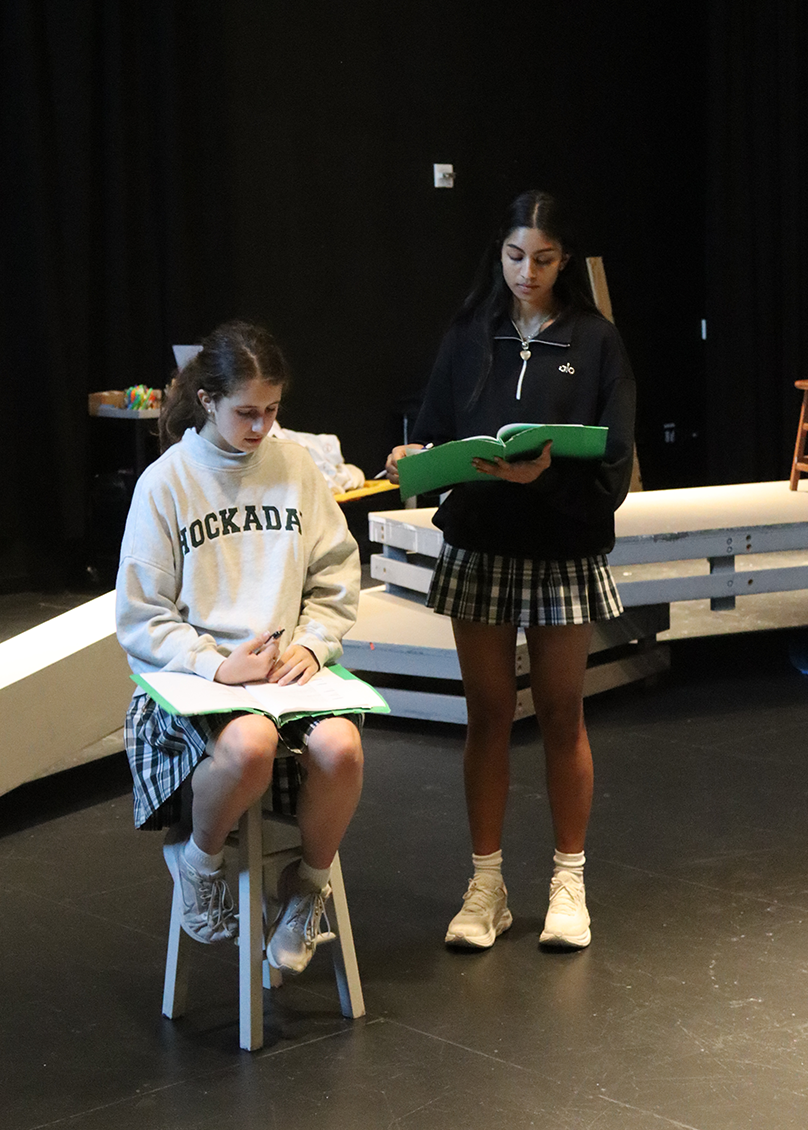
As Hockaday students, we feel as if the Upper School English department, though it has not formally stated so, has changed how writing is tested by shifting to handwritten in-class writing assignments to prevent the use of AI. However, this has caused students to question whether this solution actually fixes the problem.
At first glance, the solution makes sense. In-class writing is a foolproof way to ensure no artificial intelligence is used on English papers, and the results prove that there are no real ways to cheat that system. Yet, the writing itself doesn’t provide any real way to hone skills, as it prioritizes efficient time management and introducing, explaining and concluding an idea in just 85 minutes. Writing assignments require time and care through tedious editing and meticulous arguments to prove your point; in-class writing simply cannot make up for those skills.
Additionally, when writing in-class essays, specific conditions are imposed as you are required to finish within a certain amount of time. These essays place unnecessary pressure on students and result in poor-quality writing. Writing effective essays is a process that includes drafting, revising and sometimes even starting over. Because most in-class essays are handwritten, this process is complicated, further adding to students’ stress. Students lose the critical ability to think profoundly and truly analyze the topic at hand when under time pressure. Yet, since students naturally aim for the highest grade possible, they prefer a completed, less analyzed essay over a calculated idea in a half-baked essay due to time restraints.
Although we have an abundance of Hockaday resources for writing help, many of these benefits are diminished by only in-class writing. The Writing Center has helped students for years and remains a valuable resource. However, when writing in class, students may not have any opportunities to conference with the writing experts. Additionally, conferences are essential for gaining a better understanding of your teacher’s expectations and for receiving meaningful feedback. These opportunities are also lost in some types of in-class writing, and students are expected to complete their papers independently and without guidance, which is a difficult skill to hone without proper preparation and a certain diligence.
Despite its negative aspects, there is a place for some in-class writing. Because of time constraints, students learn how to write quickly and efficiently, which is especially beneficial for timed exams and assignments. The writing format also reduces procrastination due to its time sensitivity and demands sustained focus. The writing itself is positive in many ways yet needs to be balanced with other kinds of writing assignments to hone a multitude of skills.
Even though in-class assessments are important in those ways, they target different skills than processed writing, even though both are often graded using similar standards. Out-of-class writing is typically more refined, undergoing multiple rounds of revision, including resources like the Writing Center and other teachers, which are standard for most assignments completed outside the classroom. Although in-class writing faces much stricter time restrictions, grading systems haven’t yet changed to accommodate them. If teachers are going to fully commit to the in-class only approach, the grading methods need to change as well to account for the added pressure and limited preparation time. The weight of these assignments also needs to be reduced to allow students to transition more effectively between writing systems. Giving students a grace period is key since most have been honing the same writing skills throughout most of their school education.
Ultimately, although in-class writing fosters important skills, it neglects processed writing and develops a completely separate set of skills. While concerns about academic honesty are significant, solely focusing on in-class writing ignores the reality that students must learn to work with integrity. As students striving for academic success and a strong launch pad for our future endeavors, we urge the Hockaday English Department to see our perspective and allow students to be honorable despite the popularity and publicity of Artificial Intelligence in our modern world.