























For many of Hockaday’s foreign language teachers, the path to the classroom did not begin in Dallas or even in the United States but was shaped by years of movement across countries, cultures and languages. Those experiences still influence how they teach and why language learning remains central to their lives.
Madame Fisher

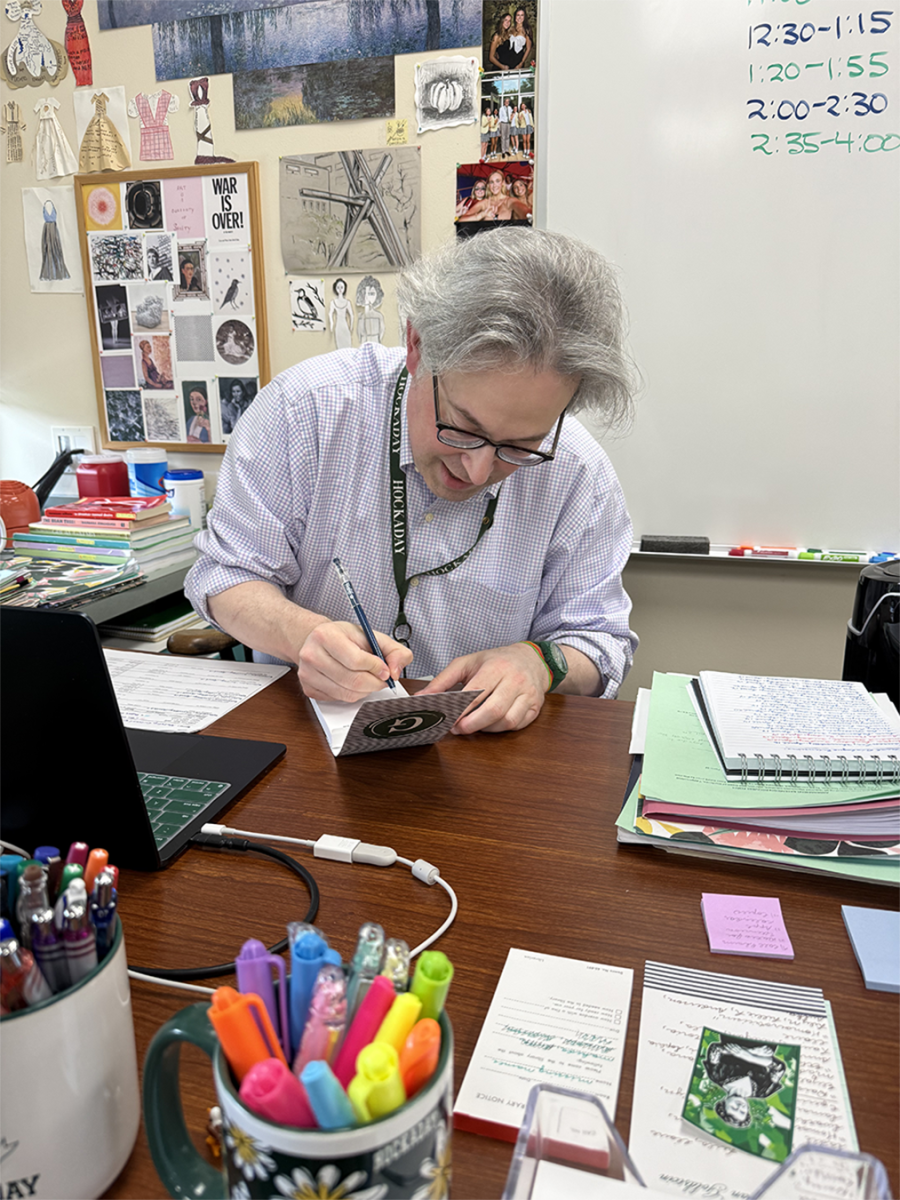
Middle School French teacher Stephanie Fisher was born in Nancy, France. At two months old, her family moved to Senegal, where she lived for nine years. When her father got a job to fix an algae problem in the Palace of Versailles, she moved back to France. After a year, they moved to the Philippines, where she lived for another nine years. As a result, adapting to new languages and cultures was a necessary part of her childhood.
“When we went to the Philippines, I was in sixth grade, and I only knew French,” Fisher said. “I went to French school but hated it, so I begged my mom to put me at the international school in the Philippines, where I had to learn English in just three months.”
Wherever she was in the world, language was always something she felt strongly attached to. Learning the language of the country she lived in became her mission with each move.
“When we lived in Argentina, I made sure to learn Spanish,” Fisher said. “When we were in Oman, I made sure to learn Arabic and when we were in Malaysia, I tried to learn Mandarin Chinese.”
Fisher took her love of language to the classroom despite not originally wanting to be a teacher.
“On a whim, I got a job teaching ninth grade English and history in Argentina because there was no French opening,” Fisher said. “The first three months, I hated it. I thought it was atrocious. And then I ended up loving it. If you teach at a school where students want to work, it’s the most beautiful job.”
After years abroad, Fisher and her family chose to settle in the United States so their children could have a stronger sense of home.
“Both my husband and I grew up overseas, and we never felt we had a home,” Fisher said. “When I had kids, we felt that it was very important to make sure that my children felt that they belonged somewhere.”
In 2016, Fisher became a foreign language teacher at Hockaday, while her husband became the head of the history and social sciences department at St. Mark’s. From her travels around the world, Fisher brings a unique perspective to the classroom.
“I love and respect all the different cultures and think that every culture brings something unique,” Fisher said. “Each language has its own peculiarity, and I think it makes you a better person when you’re capable of understanding people and culture.”
Señora Lavault
Upper School Spanish teacher Magda Lavault’s love for language began in Bogotá, Colombia, where early exposure to English sparked her curiosity.
“My family and my mom’s friends who lived in the U.S. would come to Bogota, and kids my age would be speaking English,” Lavault said. “I was attracted to that difference in culture, and I remember from a very early age saying that I want to learn English.”

As a way to meet other people and connect to other ways of thinking, Lavault pursued her passion for language in the classroom, studying German in high school and French in college. As she grew up, her path to the United States was shaped by a complicated perception of the country.
“I actually grew up with a lot of influence of countries like Cuba and the idea of U.S. imperialism, so my generation grew up with a very bad idea of what represents the U.S.,” Lavault said. “I didn’t come to the U.S. until my thirties.”
Lavault ended up at Hockaday through her search for teaching opportunities at an all-girls school.
“My first experience as a teacher was when I was 22, and I taught at an all-girls school in Colombia,” Lavault said. “As students, girls are so patient and dedicated, and you can feel that ambience in the classroom, so I came to the U.S. looking to teach girls.”
For Lavault, language means more than memorizing vocabulary lists and grammar rules; it’s a way to connect to real people. In a society heavily influenced by technology, Lavault emphasizes that language learning extends far beyond the internet and translation tools.
“I think that human connection to culture through language is different than having a machine translate for you,” Lavault said. “A machine will never connect you to real people. The best thing that you can do is to talk to a person who speaks the language that talks to their hearts and to their minds. It’s a way to show people that we care, and it’s not about speaking perfectly but trying.”
Zhang Laoshi
Zhang visits China.Born and raised in China, Upper School Mandarin teacher Yan Zhang shares a similar teaching approach. Zhang’s classroom at Hockaday is shaped by a lifelong relationship with language, culture and identity.
“As a native speaker of Chinese, I was deeply immersed in the language from an early age, and through it I developed a strong connection to Chinese history, literature and cultural values,” Zhang said.
Zhang came to the United States when her husband began pursuing his Ph.D., a move that eventually led her to teaching. She realized during her graduate studies that education offered a meaningful way to share her passion while preserving her cultural identity.
“I was drawn to teaching as a way to convey what I have learned, thought and experienced to a wider audience,” Zhang said. “Becoming a language teacher allows me to maintain and express my own cultural identity within a multicultural environment.”

Like Lavault, Hockaday’s all-girl environment proves rewarding to Zhang.
“Girls often bring emotional sensitivity and insight to language learning, and many have a natural inclination toward expressing themselves through language and literature,” Zhang said. “They are also especially engaged in exploring personal identity through cultural understanding and communication.”
Through her class, Zhang hopes her students take away a lasting sense of curiosity and a habit of continuous learning. Through language study as a medium, they can continue to explore literature, history and culture in an ongoing and meaningful way.
“Language catalyzes developing empathy, allowing students to respect and understand different perspectives and viewpoints and to build meaningful connections with others and with cultures beyond their own,” Zhang said. “I aim for students to cultivate confidence, enabling them to express themselves clearly, explore their own identities and approach the world with an open mindset, ultimately preparing them to become global citizens and even future leaders.”