


























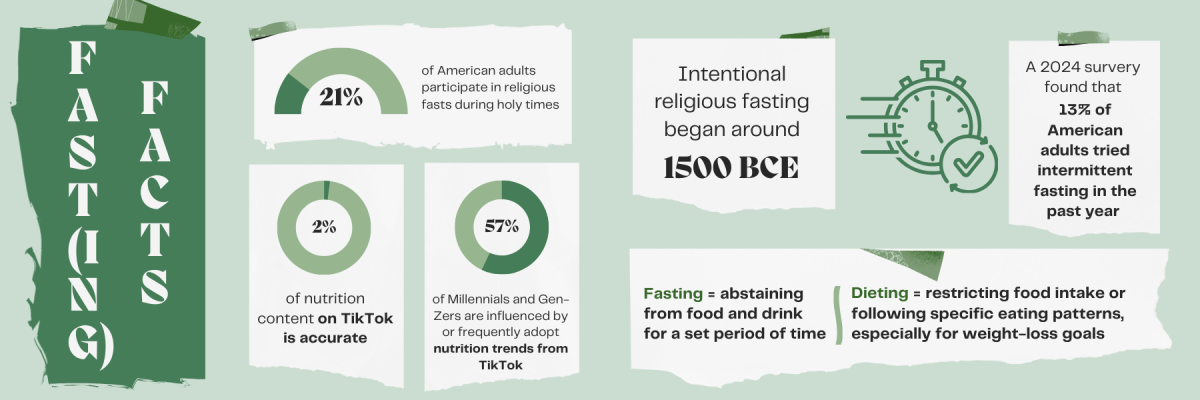





Preservatives. Additives. Chemicals. Red Dye 40. Debates surrounding what ingredients belong in foods have remained in question for years. Online platforms with health influencers who claim to be experts or doctors describing perfect lives from their new diet or vitamin while demonizing carbohydrates and processed foods. In the whirlwind of dietary information constantly circling students and adults, it is challenging to decipher what is truth and what is myth.
Melanie Jenkins, Upper School Health and Physical Education teacher, believes that critical thinking is extremely important when choosing whether a source is accurate and reliable. In the social media unit of her Form IV health class, she reminds students not to trust everything they see online.
“We were talking about social media, and influencers promoting supplements or things like that,” Jenkins said. “That is something that’s driving profit, so you have to critically think about that. What is the creator getting out of content like that? Are they being commissioned? How does that play into their reliability?”
In addition to teaching students how to evaluate the truthfulness of online material, Jenkin educates them on how to recognize which diets may not be healthy. Fad diets, those which promise quick weight loss without scientific evidence to back them up, are especially important to look out for online.
“If a fad diet is saying that you should cut out a main food group or macro or micronutrient, that’s a red flag because we need all of our macro and micronutrients,” Jenkins said.
Jenkins also spends a unit in her Form I health class discussing nutrition. While she teaches her students the importance of eating a healthy diet with less processed foods, she also believes it is important to form a sustainable diet.
“I often tell students in my class, sometimes we want a cookie, and that is a highly processed food,” Jenkins said. “But it is okay to have that every once in a while because that is going to make us more sustainable on our diet.”
Upper School Science teacher Carol Taylor uses her scientific knowledge to explain her idea of a good diet. She spent the last semester teaching her epidemiology class about healthy and unhealthy microbiomes.
“I think diet raises the question of, if I am having more processed foods, how is that affecting the health of the microbiome,” Taylor said. “I think there is absolutely an association with the health of the microbiome and susceptibility to disease.”
In order to maintain a good diet, Taylor focuses on the balance of her meals.
“I try to make it so that the meat is not the star,” Taylor said. “A quarter of my plate is for meat, another quarter is for carbohydrates and vegetables take 50 percent.”
Hockaday nurse Katie Barnes has found that there is no perfect diet. The most important parts of diet are getting enough protein, eating high quality food and minimizing highly processed foods.
“I think the most important thing to having really good health and nutrition is to eat whole foods, mostly plants and food that has not been processed,” Barnes said.
Barnes believes that preservatives and additives have a less direct effect on health. Rather, it is .
“I don’t know that the particular additives are necessarily so bad,” Barnes said. “I think a lot of the hype about them being dangerous or bad is kind of overblown. But if someone’s eating food with a lot that’s processed and has a lot of additives and preservatives, then that means they’re not eating the fresh food and that’s really more of the problem.”
As a whole, dietary information provided online is more often than not incorrect.
“People end up restricting their diet in ways that aren’t necessary and aren’t helpful,” Barnes said. “If they could keep it simple and mostly eat plants and simple preparations then they’re probably going to be okay.”
While consuming highly processed food with preservatives and additives is detrimental to health, the best diet is often the simpler and more individualized one.
“To me, a good diet means you have all your macro and micronutrients,” Jenkins said. “You have protein, you have carbohydrates, you have healthy fats, vitamins and minerals. You’re feeding yourself sufficiently given the activity you’re doing.”
